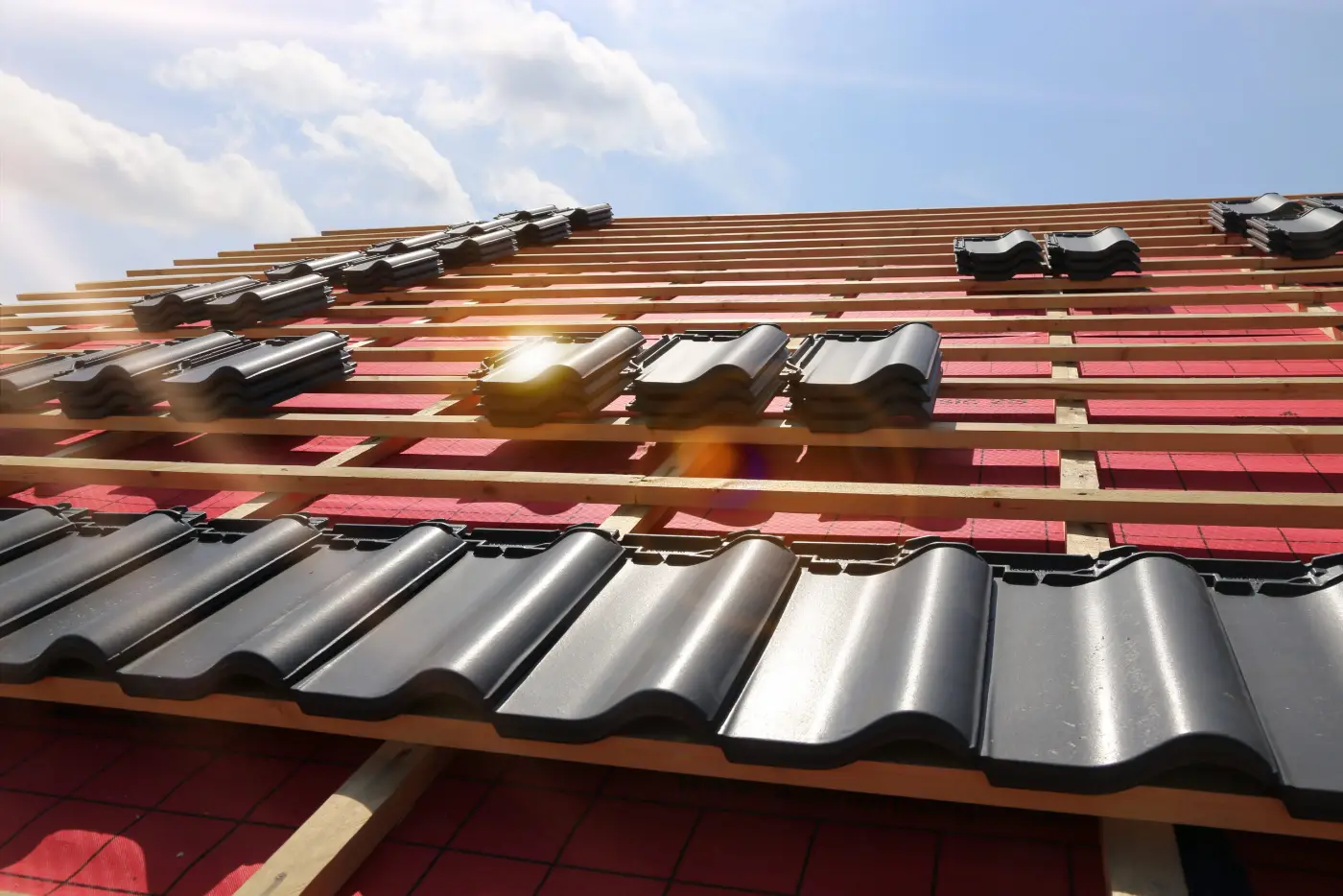


The short answer is yes. Roofs are replaced in New Jersey through the winter every year, and for some homeowners it is the better time to do it. The longer answer is that cold weather changes a few specific things about how shingles behave, and whether your roof turns out well depends on whether the crew accounts for them.
The one thing that genuinely changes
Asphalt shingles are not held down by nails alone. Each shingle has a strip of thermally activated adhesive on its underside. Once the roof warms in the sun, that strip softens and bonds to the shingle below, and the roof becomes a single sealed surface. That bond is what resists wind uplift, and it is why a properly sealed roof survives a storm that strips an unsealed one.
In cold weather the adhesive does not activate on its own. The shingles go down correctly, they are nailed correctly, and they simply have not bonded yet. On a sunny January afternoon a south-facing slope can get warm enough to seal. A north-facing slope in February may not seal until March.
This is not a defect and it is not a reason to avoid winter work. It is a reason to ask what the crew does about it.
Hand-sealing, and why it is the question to ask
The accepted practice for cold-weather installation is to hand-seal: a manufactured asphalt roof cement applied in the specified spots under the shingle tabs, in the specified quantity, as the roof goes on. Done to the manufacturer instruction it produces a bond immediately rather than waiting on the weather.
Two things separate a crew that does this properly from one that does not. The first is whether they do it at all. The second is whether they do it correctly, because too much cement in the wrong place causes shingles to blister and buckle as the roof heats up in spring. Correct hand-sealing is small dabs in the right positions, not a stripe across the whole shingle.
Ask the question directly: in cold weather, do you hand-seal, and where. It is the single most informative question you can ask about a winter roof.
Shingles get brittle
Below roughly forty degrees, asphalt shingles stiffen. They are more likely to crack when bent, particularly along the cut edges, and cutting them cleanly takes more care. Bundles left out overnight in the cold are harder to work with than bundles kept warm and brought up as needed.
This is a handling issue rather than a material one. Experienced crews keep bundles somewhere warm, score rather than snap, and slow down on the detail cuts around valleys and penetrations. The visible symptom of a crew that did not is cracked shingles along the hip and valley lines in the first spring.
Nailing and the self-adhering membrane
Two smaller cold-weather points are worth knowing. Pneumatic nailers behave differently in the cold and need watching, because an overdriven nail cuts through the shingle mat and an underdriven one leaves the head proud and telegraphs through the course above. Both show up later as wind damage.
The ice barrier membrane also needs a clean, dry, reasonably warm deck to bond. It will not stick to frost. That is part of why winter work happens in weather windows rather than on a fixed date, and why a crew that will not start until the deck is dry is showing good judgment rather than stalling. There is more on what that membrane does in our piece on what goes under your shingles.
Shorter days, smaller bites
The practical constraint in December and January is daylight. A summer crew can strip a large roof and close it in the same day. In winter the sensible approach is to tear off only what can be dried in before dark, which means a large roof takes more days than the same roof would in July.
That is a scheduling reality rather than a quality problem, but it should be reflected in what you are told to expect. A contractor promising a full winter tear-off and install on a big colonial in a single short day is promising something you do not want.
When waiting is the wrong choice
Plenty of roofs can sensibly wait for spring. Some cannot, and the distinction is usually obvious.
- An active leak. Every freeze-thaw cycle moves water further into the deck, the insulation and the ceilings. Waiting three months turns a roofing job into a roofing and drywall job. Our guide on what to do when a roof is leaking covers the immediate steps.
- Storm damage. Missing or lifted shingles will not survive the next nor easter, and an insurance claim generally expects you to prevent further damage rather than watch it accumulate.
- A deck that is already soft. Structural deterioration does not pause for the season.
- A roof that barely got through last winter. If you spent January watching the ceiling, that is information.
The genuine advantages
Winter work is not a compromise in every respect. Scheduling is easier, because the calendar is not full. Crews are not being pulled between jobs. Lead times on materials are shorter. And a roof replaced in February is a roof that is finished before the spring rain and the summer heat, rather than one you are still thinking about in June.
There is also something to be said for not competing for a contractor in the first warm week of April, when everyone who has been watching a stain since Christmas calls at once.
What to ask before booking winter work
- Do you hand-seal in cold weather, and where do you place the cement?
- What temperature do you stop working at, and what conditions make you postpone?
- How much roof will you open in a day, and how is it protected overnight?
- How are bundles stored and kept warm on site?
- Does the shingle manufacturer have any cold-weather instruction for the product you are installing, and are you following it?
A contractor who answers those specifically has done winter roofs before. One who waves the question away has either not done many or is not thinking about it, and on a January roof that difference shows up the following autumn.
We work through the winter across Monmouth and Ocean counties and are straightforward about when a roof should wait and when it should not. If you are weighing a roof replacement and wondering whether to sit on it until spring, that is a question worth asking now rather than in March.