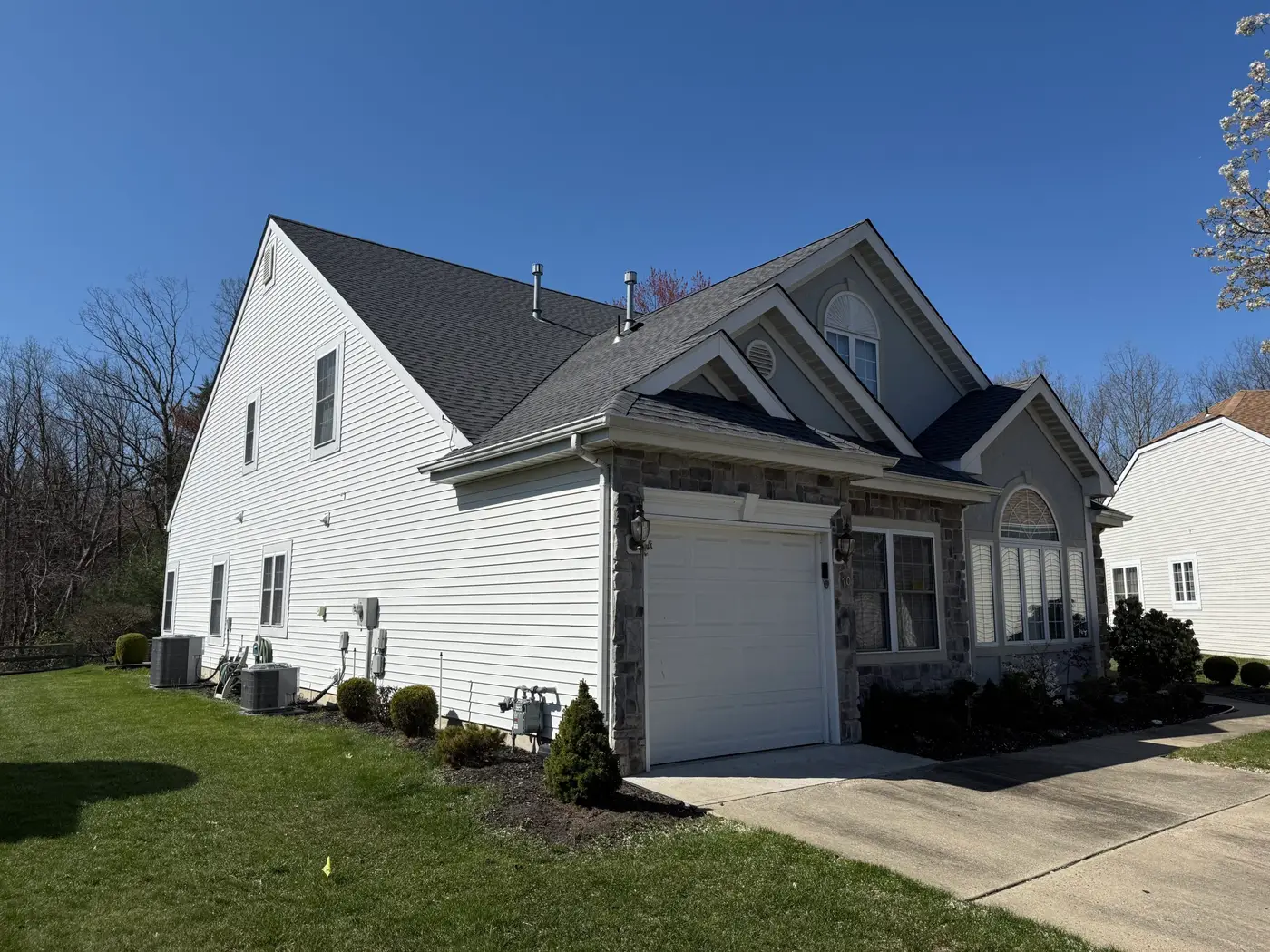

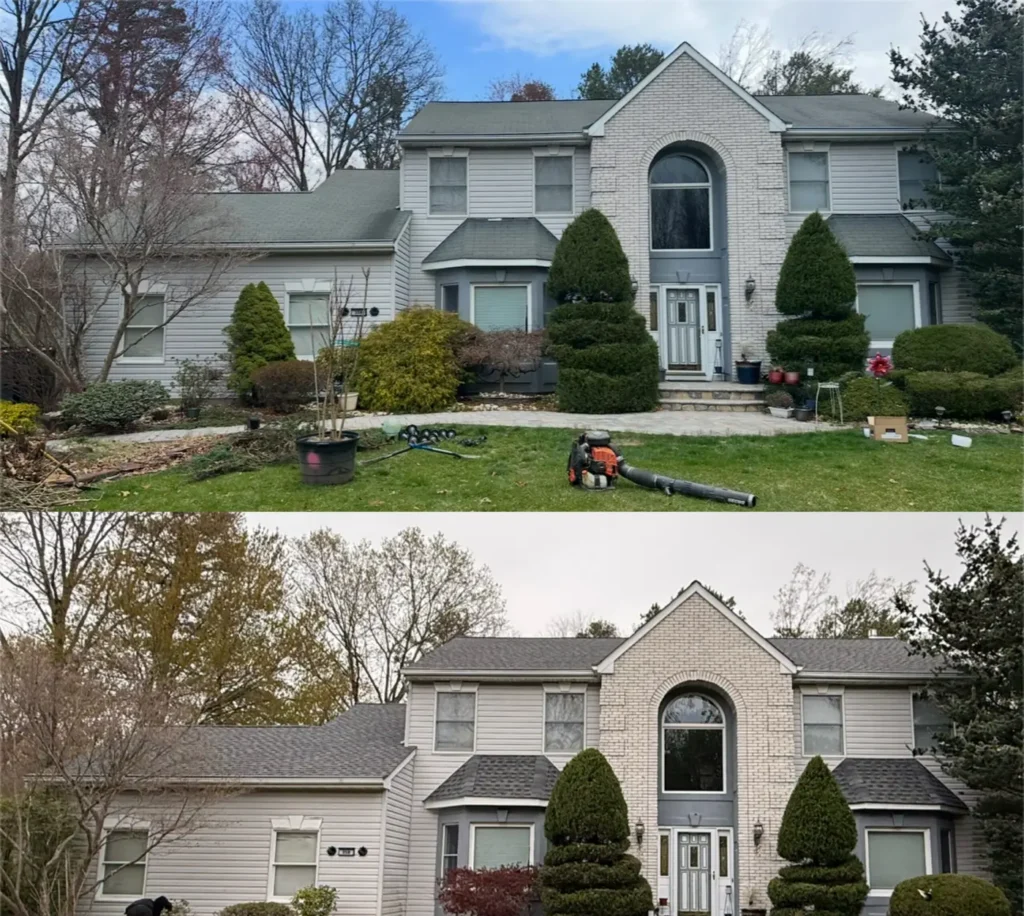
Dark streaks running down a roof are the most common thing homeowners call us about that turns out not to be a leak. They show up on the north side first, they spread downward, and they make a ten-year-old roof look finished. Most of the time it is not.
The streaks are alive
What you are looking at is a blue-green algae called Gloeocapsa magma. It arrives as airborne spores, lands on the roof, and feeds on the powdered limestone that manufacturers mix into asphalt shingles as filler. The algae itself is pale. The dark color comes from a protective sheath it grows to survive sunlight, which is why the staining reads as black or dark brown rather than green.
It spreads the way water does. Colonies establish near the ridge, rain carries them down the slope, and you end up with a vertical drip pattern rather than random blotches. Anywhere water is channeled, the streak is darker.
Why it is so common here
Algae needs moisture and shade, and Monmouth and Ocean counties supply both generously. Humidity off the ocean and the bays keeps roofs damp well past sunrise. Mature oak and pine cover across the inland towns keeps whole slopes from ever drying fully. North-facing planes get the least sun, hold moisture longest, and almost always stain first, which is why one side of a roof can look a decade older than the other side of the same roof.
A shaded lot within a few miles of the water is close to a guaranteed candidate. None of that means the shingles are failing.
Algae, moss and lichen are three different problems
People use the words interchangeably. The distinction matters, because only two of the three are worth worrying about.
- Algae lies flat. It stains the surface and has no depth. Run a hand across it and you feel shingle. This is cosmetic, with one caveat covered below.
- Moss is green, spongy and sits proud of the surface, usually collecting along the bottom edge of shingle courses where debris gathers. Moss holds water directly against the shingle, lifts the edges as it thickens, and in a freeze cycle that water expands under the tab. Moss is a real problem and it gets worse every season you leave it.
- Lichen looks like a flat gray-green crust. It bonds into the asphalt itself and cannot be removed without taking granules with it. Lichen usually means the roof is old enough that cleaning is the wrong conversation.
Does algae actually damage the roof?
Mostly, no. It is not eating the asphalt and it is not creating a path for water. The two honest arguments against leaving it are that a dark roof absorbs more heat, which does the attic no favors in August, and that heavy colonization can loosen granules over a long enough period. Neither turns a sound roof into a failing one.
What algae does do is disguise problems. Uniform streaking across a plane is algae. Dark patches that are not streaked, particularly where the surface looks rougher or pitted, are usually granule loss, and that is a different conversation about how much life the shingles have left. If you cannot tell which you are looking at from the ground, that is a good reason to have someone up there.
What not to do
Do not pressure wash it. This is the mistake that turns a cosmetic issue into a real one. A pressure washer strips the granule layer that protects the asphalt from ultraviolet light, and it can drive water up under the shingles. Roofs cleaned this way often look excellent for a season and then age visibly faster. Shingle manufacturers are explicit that high-pressure washing voids coverage.
Do not improvise a bleach mix and soak the house with it. Chlorine runoff kills foundation plantings, discolors decking and hardware, and corrodes aluminum. If a bleach-based cleaner is used at all, everything below has to be wet down first and rinsed afterward, and the mix has to be dilute.
Do not walk a wet, algae-covered roof. It is genuinely slick, more so on a steep pitch, and it is not worth it to save a phone call.
What actually works
The accepted method is low-pressure cleaning, often called soft washing: a cleaning solution applied at garden-hose pressure, given time to work, then rinsed. Done properly it removes the staining without touching the granules. On a single-story ranch with a walkable pitch, a homeowner with the right solution and a good ladder can manage it. On anything two stories, steep, or shaded enough that the roof stays wet, it is worth paying someone with fall protection.
The streaks may not vanish the day you rinse. Dead algae weathers off over several weeks of normal rain, and a roof that looks eighty percent better after a week is behaving normally.
Keeping it from coming straight back
Cleaning treats the symptom. Three things address the cause:
- Zinc or copper strips near the ridge. Rain picks up trace metal ions as it passes over the strip and carries them down the slope, which suppresses regrowth. It is inexpensive and unobtrusive, though the effect weakens toward the bottom of a long slope.
- Cut the branches back. Shade and constant leaf drop are what make one slope worse than the others. Getting limbs off the roof plane helps the algae problem, the debris problem and the gutter problem at once.
- Specify algae-resistant shingles at replacement. Most current shingle lines include copper-bearing granules for exactly this reason. If your roof is close to replacement anyway, cleaning a failing roof is money spent twice.
When a stain is not algae
A few patterns deserve a closer look rather than a cleaning quote. Staining concentrated on one plane directly above a bathroom or kitchen often points to warm, moist air reaching the underside of the deck rather than anything growing on top of it. Streaking that starts at a chimney, a skylight or a wall intersection can be rust or sealant washing down, and those are the places roofs actually leak. A dark band along the very bottom edge of the roof, especially with a sagging gutter beneath it, is usually a drainage problem.
The short version
Black streaks on a New Jersey roof are almost always algae, almost always cosmetic, and almost always fixable without touching the shingles. Moss is the one that deserves urgency. Before you spend money on either, it is worth knowing which you have and how much roof you are cleaning, because an afternoon spent on a roof with four years left in it is an afternoon wasted. We look at roofs across Monmouth and Ocean counties every week and can usually tell you which situation you are in without much ceremony.