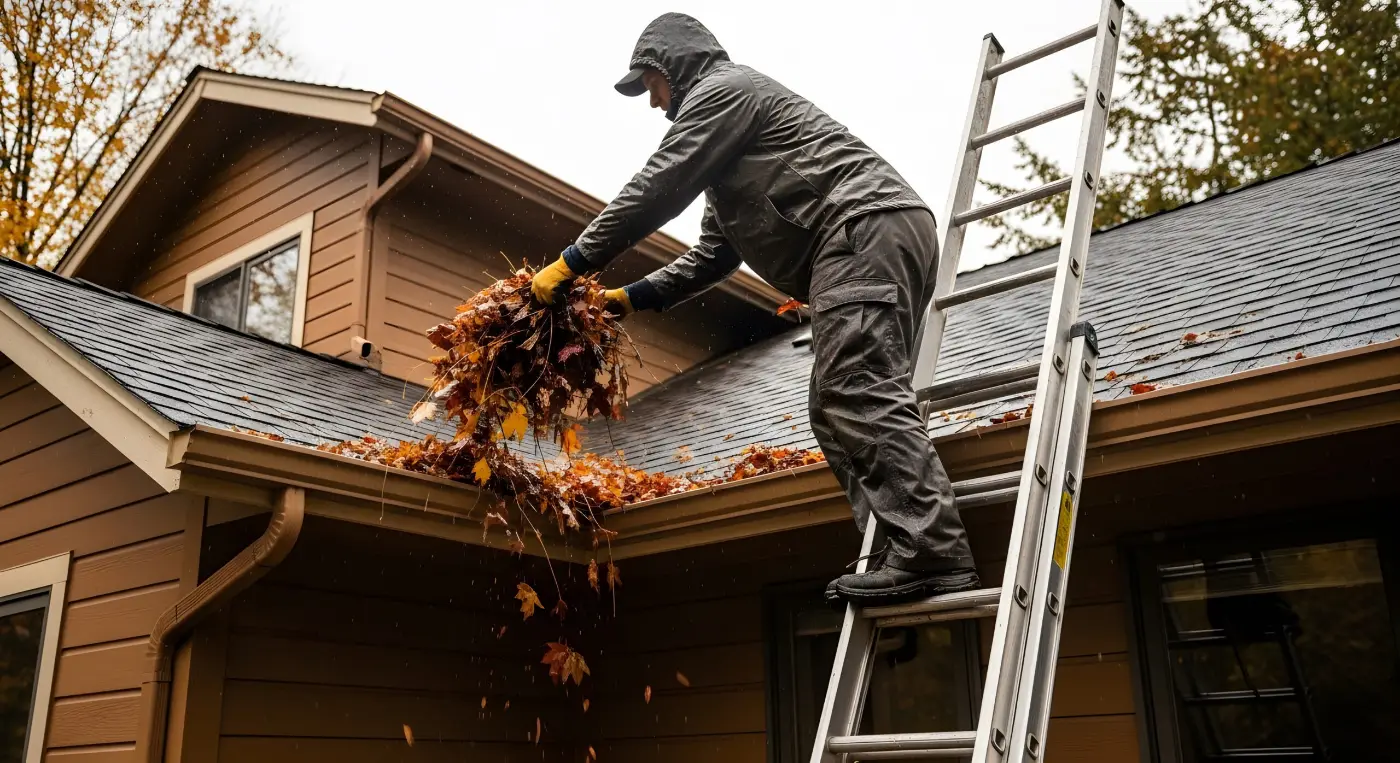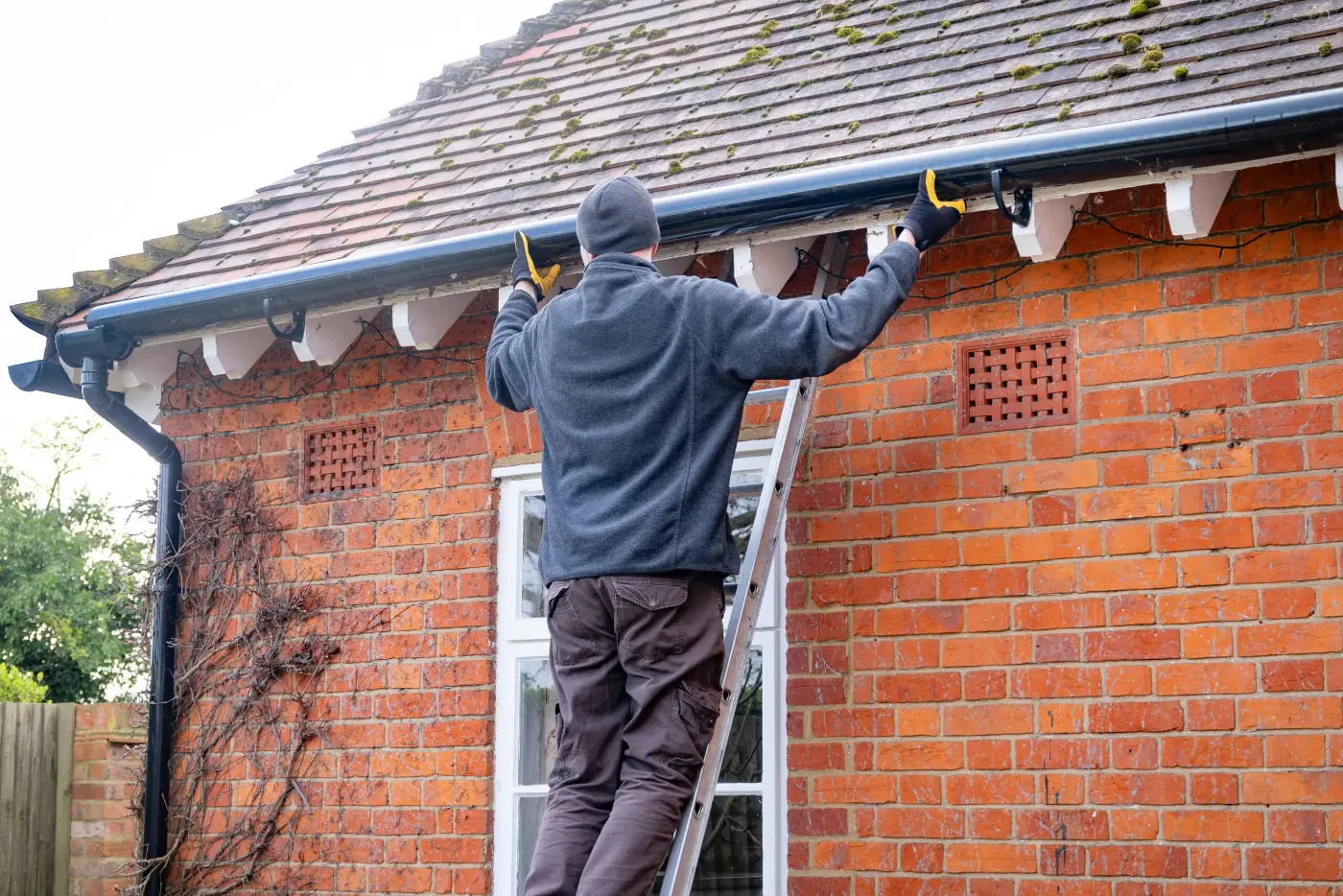


The honest answer is that good gutter guards, installed properly, will take you from cleaning gutters two or three times a year to checking them once. They do not make gutters maintenance-free, and anyone who says otherwise is describing a product that does not exist.
That is still a real improvement, particularly on a two-story house. It is just not the improvement most people are sold.
Know what is actually filling your gutters
Before you shop, spend two minutes looking at what comes out when the gutters are cleared. The answer varies enormously across this area and it decides which product is worth buying.
- Oak catkins are the spring problem, and they are why a lot of people who thought gutter cleaning was an autumn chore end up on a ladder in May. They are small, stringy, and they mat together into a felt that sits on top of a screen and blocks it.
- Maple seeds behave similarly. They germinate in the gutter if there is any soil, which is how you end up with saplings growing out of a second-story eave.
- Pine needles are the hardest case, and they matter more here than in most of the state. Along the western and southern edge of Ocean County, through Jackson, Manchester, Lacey and Plumsted, pitch pine is the dominant tree. Needles are thin enough to thread through most screens and long enough to bridge and clog what they cannot pass.
- Shingle granules come off every roof, and they are the silent one. Granules wash down, settle at the low end, and gradually build a gritty sludge that no guard prevents.
A house surrounded by pines has a fundamentally different problem from a house under a pair of maples, and one product does not serve both.
The four types, and how each one fails
Perforated screens and mesh panels. The cheap, common option, usually aluminum or plastic, sitting over the gutter opening. They keep leaves out. Catkins and pine needles either pass through or mat on top, and the mat is worse than an open gutter because water then sheets straight over the front. Inexpensive to fit, and fine under deciduous trees with big leaves.
Foam inserts. A block of open-cell foam pushed into the gutter channel. Easy to install, genuinely cheap, and the shortest-lived of the group. Debris collects on and in the foam, it holds moisture, and in this climate it tends to grow things. Most get replaced within a few years.
Brush inserts. A long bristle cylinder laid in the trough. Same idea and roughly the same outcome: needles and seeds lodge in the bristles, and clearing them means pulling the whole brush out, which is no easier than cleaning the gutter was.
Reverse-curve, or surface-tension, guards. A solid hood that curls over the front edge. Water clings around the curve into a narrow slot while debris carries past. These work, and they are the ones most often oversold. In heavy rain, which is exactly when a Jersey downpour arrives, water can overshoot the curve entirely. They are also visible from the ground, and on a steep roof the sheer volume coming down the slope can defeat the effect.
Micro-mesh. A fine stainless screen over a rigid frame. This is the only category that reliably handles pine needles and catkins, because the aperture is smaller than the debris. The trade-off is that fine mesh eventually blinds over with pollen, shingle grit and roof dust, and it needs brushing off. The good ones are easy to brush from a ladder. The poor ones are sealed in place and have to be pried off.
What a guard cannot fix
A surprising share of the calls that start as a gutter-guard question turn out to be something else. Guards do nothing for:
- Undersized gutters. Five-inch gutter on a large, steep roof plane will overshoot in a hard rain no matter what sits on top of it. That is a sizing problem.
- Wrong pitch or sagging hangers. Water standing in a gutter is a slope problem. Adding a guard hides it.
- Too few downspouts, or downspouts dumping in the wrong place.
- Rotted fascia. If the board behind the gutter is soft, fastening a guard system to it is throwing good money after bad. Fix the wood first.
If any of that sounds familiar, a guard is the second thing to buy, not the first. Our gutter installation and repair page covers what a proper rebuild involves.
Installation matters more than the brand
Two details are worth insisting on, because they cause most of the trouble we see after the fact.
The first is how the guard attaches. Many systems are designed to slide under the first course of shingles. Done carelessly, that lifts shingles, breaks the seal, and on a newer roof it can compromise the manufacturer warranty. Ask directly whether the system goes under the shingles, and if it does, ask how the installer protects the seal.
The second is that the guard now ties the gutter to the roof. If the gutter has to come off later, the roof edge is involved. That is not a reason to avoid guards, but it is a reason to have the roof and the gutters looked at as one system rather than two separate purchases.
Who they are genuinely worth it for
Guards pay for themselves when the alternative is expensive or unsafe. Two or three stories, a steep pitch, a shore house you are not at every week, tall mature trees directly over the roof, or a homeowner who should not be on a ladder at all. In those cases, cutting three cleanings a year down to one inspection is straightforwardly worth the money.
On a single-story ranch with a clear yard, where clearing the gutters is twenty minutes with a step ladder twice a year, the economics are much less convincing. It is a fair thing to say out loud, and it is why we do not treat guards as an automatic recommendation.
What to ask before you sign anything
- Which of my trees is this product designed to handle? If pine needles are the issue and the answer is a perforated screen, keep asking.
- Does it fasten under the shingles, and how is the roof protected if it does?
- Can the mesh or hood be cleaned from a ladder, or does it have to be removed?
- Are my existing gutters and fascia sound enough to carry it?
- What exactly does the warranty cover: the product, the installation, or a promise that the gutters will never clog?
That last one separates most of the market. A guarantee against clogging usually comes with conditions that make it hard to claim.
One last thing about this time of year
Whatever you decide, the gutters want to be clear before the first hard freeze. Water sitting in a blocked gutter through a January thaw is how ice works its way back under the roof edge. If you are weighing guards for next spring, that does not change what needs doing this month, and our note on fall gutter cleaning covers why. If you would rather hand the whole thing off, we handle gutters across Monmouth and Ocean counties.